How To Spend A Day In Vatican City
A Day in Vatican City is not only about seeing masterpieces—although you will see many—but it is also about observing how art, belief, and beauty are merged into a singular vision. It is consuming, awe-inspiring, and an experience you will always remember.
Although a spiritual endeavor, it can be intimidating and overcrowded. People swarm in from around the world to visit this ethereal place. Being prepared for the madness that can await you at Vatican City will help you tour with intention.
Plan Your Personal Reading Escape to Rome
Coming Soon!
Book a Skip-the-Line Experience
I should start by saying, please do not be fooled into believing that Vatican City is one of the places you can wander into for free. As you approach Vatican City, you are met by colonnades that form St. Peter’s Square. Called “the maternal arms of the Church,” they form a protected cove between the open city of Rome and the sacred interior of the Vatican. Without a ticket, you will stand outside of this enclosed space.
You can book directly with the Vatican, but if you sink in crowds, like I do, and can budget a little more, I’d suggest going with a skip-the-line tour. It is an extra expense you won’t regret. Keep in mind that this is usually a crowded space and by wandering alone, it’s easy to miss specific showcases.
Note: one of the reasons you get the tour guide is because they raise their badges and help escort you through crowds of people, and you cannot do this successfully if your group is also large.
Arrive early
Whether you are going a self-guided or group tour, choose the earlier timeframes as things get busier in the afternoons.
If you have a guide, arrive fifteen minutes earlier so that you can find them in the crowd. They will be holding up signs and doing group counts. After they have accounted for everyone, they will have to lead the group to the security line (even if you have a skip-the-line option), so you don’t want to be the one who holds up the group.
Dress appropriately
Vatican City is where the Pope lives. There is a dress code. While casual wear is allowed, dress to cover your shoulders and wear something that covers your knees.
Bring some form of identification
Although Vatican City may be a short ride from your hotel in Rome, it is a separate country. Vatican City is the smallest country in the world.
You will go through security and may need to show a passport or identification (in fact, don’t be alarmed when you come across armed guards at the Vatican). While this is not mandatory, you want to be prepared. It’s also possible they won’t accept your oversized backpacks, so carrying a small bag or crossbody could be fruitful.
Start with the Vatican Museums
The Vatican Museums are a blend of spaces, corridors, collections, chapels, and courtyards. You could spend about two to three hours perusing the museums. Here are four spaces you can expect to encounter:
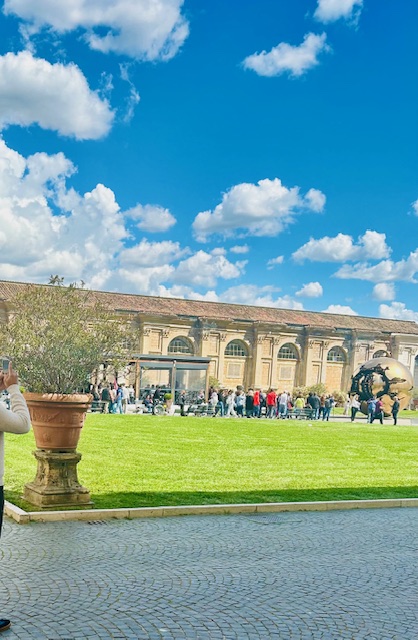
1. The Courtyard of the Pinecone
The Courtyard of the Pinecone may be your anchor before or after you walk the museums. Between the Vatican Library and the Belvedere Palace, it is along the route to the museum. It is a great place to grab a drink of water, find your grounding, and appreciate where you are. Here, you will find the modern bronze sphere by Arnaldo Pomodoro, a mix of Renaissance and contemporary art. The Courtyard is a place to regenerate and relax.
2. The Gallery of Maps
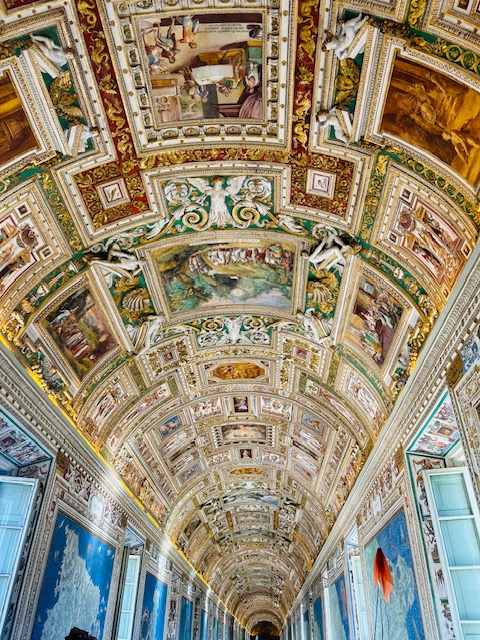
The Gallery of the Maps is where you will pass through time. With the order of the landscapes and geography, it feels like a gaze at time. The Gallery is a long corridor of about 40 maps of Italy, painted in fresco, lining the walls. It is a stunning corridor and above it, is a barreled ceiling. Walk slowly, observe, because here, travel turns to contemplation.
3. The Raphael Rooms
The Raphael Rooms are a suite of four frescoed rooms in the Museums. They were originally the private apartments of Pope Julius II and Pope Leo X. The Rooms seem philosophical, as they force you to stand still and consider. They each have different themes and history. As you explore, you will find that people, particularly art lovers and student groups, linger here to learn about the key frescos (painting technique and type of artwork) present in these spaces.
4. The Sistine Chapel
The Sistine Chapel is the only space where silence is enforced; although be warned that some people ignore this rule and still chatter. If you head to the chapel for spiritual respite, you may be disappointed by the chatter and lack of places to sit. Go prepared to wait until something opens up.
It is an architecturally beautiful space, with the objective being to sit and gaze upwards at Michelangelo’s portrayal of The Book of Genesis, The Life of Moses, The Life of Christ, and the Last Judgment. The space presents faith as struggle, and, admittedly, I found the writhing imagery to be more tense than I’d expected.
Tour St. Peter’s Basilica in the afternoon
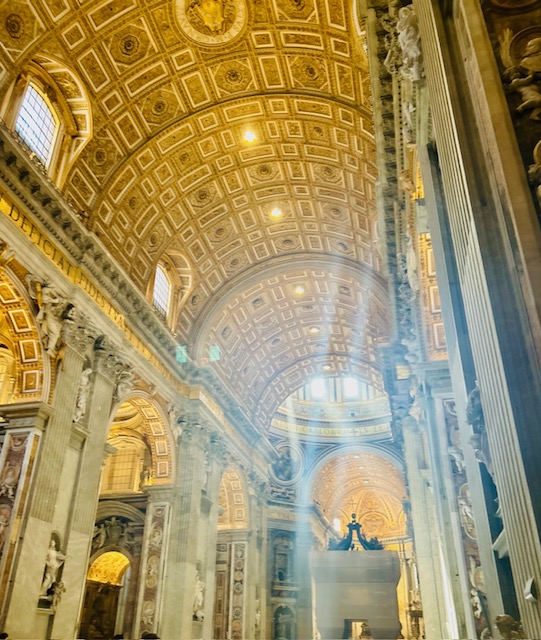
If you choose a skip-the-line experience, your tour guide will help you enter the Basilica directly from the Sistine Chapel (they have access to a connecting door, and you will realize how important this is once you see the exit options).
The Pieta is art in tenderness, art to behold from your own spiritual lens. It is Mary cradling the body of Christ after the Crucifixion. It will make you ask yourself questions; for instance, how does seeing a depiction of the mother of Jesus, as she holds his dead body, make you feel?
Bernini’s Baldacchino is another highlight of the Basilica. A bronze canopy, it rises above the high altar of St. Peter’s Basilica, directly above the tomb where Saint Peter, one of Christ’s closest disciples, is said to be buried.
Visit the Vatican Library
Founded in the 15th century, the Vatican Library is one of the world’s most important repositories of written culture. The archives are restricted to scholars, but the exhibitions are open to the public. If you are on a journey to read around the world, you cannot miss the library.
Although these are not copies you can cling to on the reading around the world trail, you will have visual access to select historical texts that seem otherworldly. The Exhibitions include illuminated Bibles, handwritten texts, and notes in margins that personalize ancient texts. Imagine feeling as if you are in another dimension. This is a good place to end on a contemplative note.
View the Vatican Gardens
The gardens have always been used by the Pope as a place of prayer. They have a monastic feel, with windy paths. The gardens seem designed for prayer, meditation, and thought. The sprinkle of small fountains adds a soothing sensory touch. There are small figures of the Virgin Mary and views of the St. Peter Dome. An additional thrill is that they have plants from all over the world. It is a great place to say a short prayer or complete brief meditation.
Final tip for a day at the Vatican: Be sure to check scheduling notes with your tour guide and on the Vatican’s website for weekly closures. Book your tour here.