Five Books From Around the World That Highlight Relationships
I enjoy reading books about how people navigate love, loyalty, and conflict, because they provide a glance into how we handle internal monologues and decisions close to the heart.
But reading about relationships from around the world offers an even better view of cultural nuances and helps me appreciate the many ways we relate to one another globally.
These five novels and novellas, from celebrated writers, hail from Russia, Japan, Austria, the Caribbean Islands, and the United States. Adding any of these novels to your home library collection is a decision you won’t regret.
Fear, by Stefan Zweig
From Vienna, this is the story of Irene, a bourgeoisie wife who is bored with her eight-year marriage and so she starts a love affair with a pianist. One day, as she is leaving his house, she is confronted by her lover’s working-class mistress who mocks Irene for her wealth and blackmails her.
Soon, Irene is doling out money regularly to her lover’s mistress who stalks and threatens to expose her. Irene gets weighed down by anguish, guilt, and fear. The story takes an interesting turn once Irene discovers what is really happening.
“What had driven her into his arms, what terrible madness had led her to embark on an adventure that her own heart no longer understood, and hardly even her mind? She knew nothing more about it, everything in what had passed was strange to her, she was a stranger to herself.”
This novella is an examination of relationships and social status, but even more so, it is an elucidation of the internal chaos that can be stirred by guilt and shame.
The Waiting Years, by Fumiko Enchi
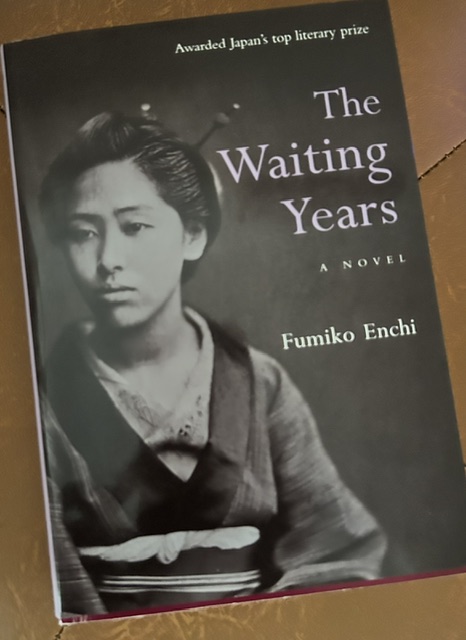
From Tokyo, this is a story that begins with Tomo, a wife who, per her husband’s request, must find him a concubine disguised as the wife’s maid. Shirakawa, a wealthy and powerful man, has grown wary of his strong, independent wife.
“Even as he sensed the passionate nature within, he was beginning to find it difficult to see her as an object of desire. The strength that was a fraction greater than his own made him feel ill at ease in her presence.”
The novel opens with Tomo and her daughter, Etsuko, having just arrived in Tokyo from Kumamoto in a rickshaw. “Born into a low-ranking samurai family of the Hosokawa clan” Tomo feels threatened as an individual, as a wife and a mother. Since she has no choice, she does what is within her control. She chooses to recruit the young girl who will become her husband’s mistress and live in her house.
A heartrending and engrossing read, this novel highlights the changing dynamics within a marriage and the relationships between women as they realize the futility of their roles in 19th century culture and society. It is a novel that is as much about class as it is power and patriarchy.
Wide Sargasso Sea, by Jean Rhys
From the West Indies, this is the story of unrequited love and unfulfilled relationships. Annette, the widow of a former slave owner, is alone with her children and her Black staff in her crumbling estate called Coulibri. After her husband’s death, when she is poor and abandoned by society—just like her former slaves—she finds it difficult to navigate life. She meets an English man, Mr. Mason, and they get married.
When Annette tries to convince her new husband to leave Coulibri and go to Antigua or Trinidad where he supposedly owns homes, Mason refuses. Even more heartbreaking is how he dismisses her explanations of the dynamics between her family and the community they’d oppressed for years. Tragedy ensues.
Years later, Annette’s daughter, Antoinette, heiress to the estate, marries an Englishman she falls in love with. Only, her new husband does not love her. The two return to the island of Annette’s childhood trauma. However, there is something foreboding on the island for a family once known as brutal slave owners.
“As for the happiness I gave her, that was worse than nothing. I did not love her. I was thirsty for her, but that is not love. I felt very little tenderness for her, she was a stranger to me, a stranger who did not think or feel as I did.”
Eerie and heart wrenching, this is not only a novel about social attitudes, race, and gender but it is also a novel that shows how poor relationships can hinder or change a person. It is a book that is hard to describe adequately because there are so many layers to this short novel. However, one thing it truly elucidates is the idea that some places of trauma can be haunting and that maybe they are not places one should revisit.
Tell Me How Long the Train’s Been Gone, by James Baldwin
From Harlem, New York City, this is the story of the actor Leo Proudhammer, who is recovering from a near-death experience after a heart attack. On his sick bed, Leo considers the life and relationships he sacrificed in order to become famous. He recalls his unconventional love life and friendship with Barbara, and his love life with another man.
“But what, I asked myself, was I to do with her? Love, honor and protect. But these were not among my possibilities. And, since they were not, I felt myself, bitterly, and most unwillingly, holding myself outside her sorrow; holding myself, in fact, outside her love; holding myself beyond the reach of my blasted possibilities.”
What is interesting is how love is illustrated: love as friendship and lust, love as a lifetime bond, love as a barrier that withholds identity crises, love as a shield against the cruel realities of social status. Love is pained in this novel, yet it is also hopeful, proud, long-lasting, and doesn’t care about the flaw in its subject.
The novel showcases the loss of identity that comes with a strive for fame, and the grit that emerges after trauma. All this as love is sacrificed. The dynamics of these relationships, coupled with the intoxication of fame told from the viewpoint of a vulnerable narrator, makes this an enthralling read and one of my favorite Baldwin novels.
First Love, by Ivan Turgenev
From Moscow, this is the story of a teenage boy’s lessons of love and relationships. When a group of men meet to share their stories of their first loves, a forty-year-old man, Vladimir Petrovitch, details the first time he fell in love. He was a teenager obsessed with Zinaida, a woman older than him. In this novel of recollection, Vladimir narrates the complexity of his teenaged obsession and the betrayals that follow.
“Over everything she did and said, over every movement, there hovered a subtle, exquisite enchantment. Everything expressed the unique, peculiar force of the life which played within her.”
This novel depicts an awakening to the adult complexities of love and the intertwining of social relationships. Turgenev once said that it was one of his most autobiographical works and was inspired by his love for someone with whom his father had an affair.
To discover new books and places to visit, join me in the Reading Europe Challenge.