My Visit to the UNESCO Villa Ocampo Observatory in Buenos Aires

A House of Words: Visiting Villa Ocampo

This month, I added another UNESCO World Heritage Site to the Reading Around the World Trail. I visited the UNESCO Villa Ocampo Observatory, in the town of Béccar, in Buenos Aires.
Villa Ocampo was once the home of the writer, Victoria Ocampo, an Argentine writer, advocate, and intellectual nominated for the Nobel Prize in Literature in 1970 and 1974.

Ocampo was also an advocate for women’s rights and an outspoken critic of authoritarianism, including her opposition to the regime of Juan Perón, which led to her brief imprisonment at age 63. The Ocampo Villa exudes her confidence, intelligence, and intellectualism.
On literature
One of the most influential cultural figures in 20th century Latin American literature, Victoria Ocampo wrote and read widely beyond Argentina’s borders. I found her home library to be a fascinating blend of her literary tastes and a reflection of her bilingual lifestyle.
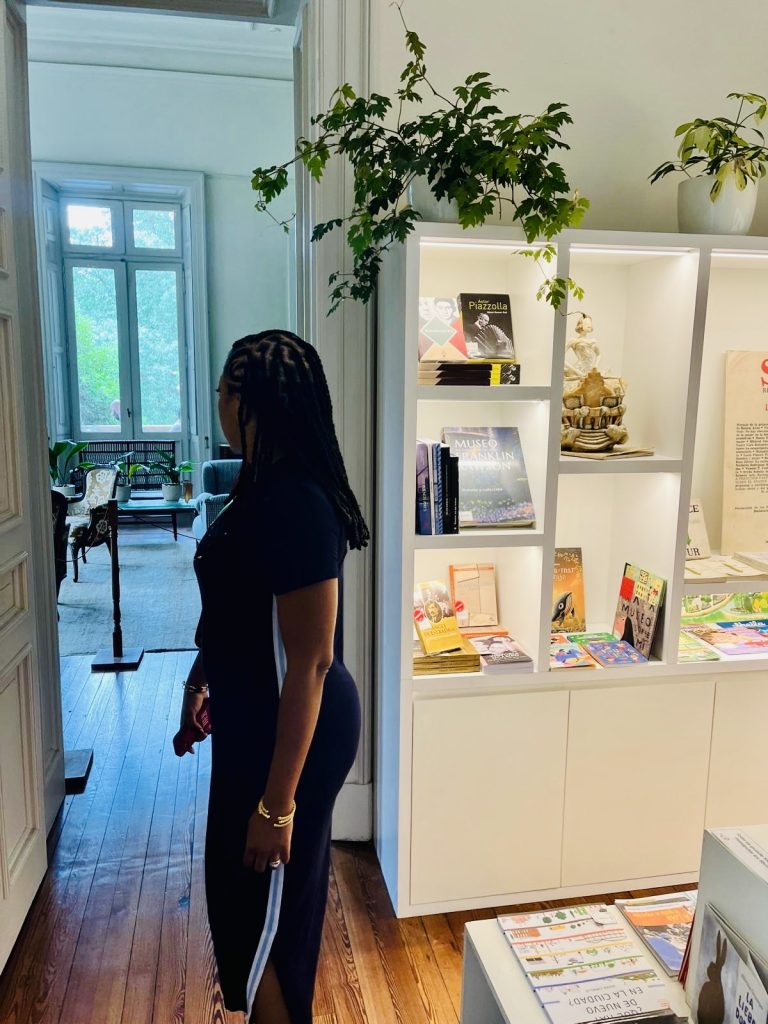
You hear often of her chief contribution to the literary world: the literary magazine Sur, which she founded in 1931. With the publication of Sur, Ocampo bridged Latin American writers and the global literary world. This is a primary reason she gifted her home, Villa Ocampo, to UNESCO as an observatory.
Through Sur, Ocampo promoted writers such as Jorge Luis Borges, Adolfo Bioy Casares, and Silvina Ocampo. She also introduced Spanish-speaking audiences to international figures like Virginia Woolf and Albert Camus, two writers whose works I listed on “The Core Shelf: 50 Novels Every Personal Library Deserves.”
The Villa as a UNESCO designation
UNESCO sites are areas with legal protection that are designated by UNESCO, the United Nations Educational, Scientific, and Cultural Organization. In coordination with UNESCO, these sites promote world peace because their nations cooperate to share achievements in education, arts, science, and culture. UNESCO sees these components as integral to eliminating poverty and improving socioeconomic conditions.
As a site of creativity, Villa Ocampo provides education through literature and art. The observatory helps broaden the perspective of participants and students, encourages global conversations, and elucidates culture. While there, I watched as groups awaited their turn to explore the villa, walk the grounds, and participate in a presentation.
Encouraging readers and writers from around the world
Victoria Ocampo wanted her home to be “a place of meeting, discussion and shared solitude,” according to the Association of Friends of Villa Ocampo. Writers, artists, and thinkers once gathered within those walls to discuss big ideas.
From the grand piano to the display of art and books in her home, you sense immediately that her legacy is not only a request, it is a reflection of how she lived. I walked through and imagined planning a day of reading to explore Latin American literature and its influence within the global literary arena.

Outside, the gardens expand into breathtaking views of green mixed with bright colors, and special trees like Olive, Eucalyptus, and Gingko Biloba trees. There is serenity in the nature that complements this literary house.
Glancing back towards the house, one realizes that not only do the outdoor terrace areas embrace the idea of a literary salon but the texture and layout also echo the purpose of being in conversation with literature.