Love and Garbage: A Prague Reading and Travel Guide
If we look closely, will we find that some material things we fight so hard to keep, are just garbage? In Love and Garbage, the second book of our August Reading Challenge, our protagonist, a writer and street-sweeper, wrestles with similar thoughts daily.
During the Reading Europe Challenge, we are Reading Prague in August. Join us from your bedroom, train, or plane ride as we build our personal libraries and reading prowess by reading around the world.
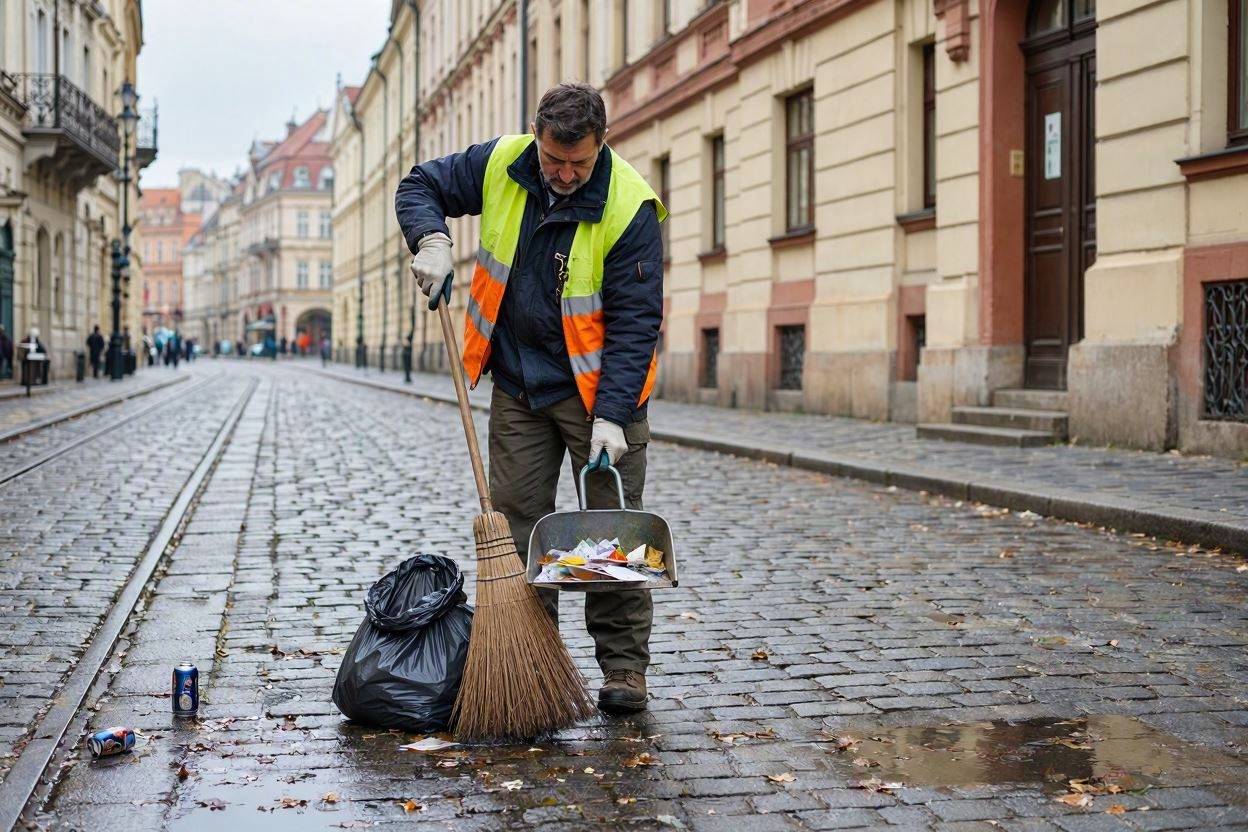
Our protagonist walks the streets of Prague with his garbage cart, discarding forgotten and used objects. Banned from writing, he also feels like a discarded object.
He writes. He copes with the memories of death he witnessed as a child survivor of the Prague Ghetto. The tension within him becomes rotten, like the garbage he sweeps.
Join us in reading this second book on our list, the poignant contemporary novel from Ivan Klíma: Love and Garbage . You can purchase your copy below and to get caught up to the challenge here.
The Story
The narrator of this novel is a writer who has abandoned his work-in-progress—an essay on Kafka—and exchanged his writer’s pen for the garbage cart of a Prague street-cleaner. As he works, he thinks about the former Czechoslovakia and the conflict it has endured; he considers life, art, marriage, and love. He is a writer caught in the middle of an affair, and the palpability of his dishonesty is afflicting, turning his thoughts to garbage.
At the core of the narrator’s inner thoughts are two women: Lida and Daria. He wrestles with different feelings of love he has for each: one deepened by marriage and understanding of another, the other representing his suppressed yearning for freedom and another kind of life.
His dilemma forces you to consider love, its many layers and complexities. Love and garbage as competing themes help you see (and maybe even try to understand) the narrator’s skewed and perplexing perspective. You want to yell, wake up, stop being a fool, and then you realize that’s the point, he is trying to wake up.
“Nights descend, prison nights, nights as long as life, her face is above me, my wife is beside me, I am alone with my love, with my betrayal.”
The underlying story develops slowly and artistically, as if it has no desire to impress, only a need to stimulate.
About the Novel
This is a book of many layers, with transitions that seem jolting, occurring suddenly after dialogue or sometimes in the middle of beautifully descriptive exposition.
This novel was Klíma’s most successful book. It was banned from publishing until Czechoslovakia became the Czech Republic.
Approximately 224 pages, this novel is Kafkaesque, with dreamlike scenes, inner revelations, and disparate elements that both baffle and inform.
About the Author
Born as Ivan Kauders in Prague, Ivan Klíma was a Czech novelist, memoirist, and playwright. He was a survivor of the German Invasion of Czechoslovakia in 1938, and the Terezin concentration camp.
Klíma was awarded the Franz Kafka Prize in 2000. To prepare to write this novel, he spent some time street-sweeping.
A Guide for Your Reading Group Discussion
- The narrator tells us that sometimes, “unless you look at the world and at people from a new angle your mind will get blunted.” Did this phrase make you pause to consider your own experiences? If so, how?
- As you read about the writer’s past as a banned writer, particularly when he mentions that he kept writing even when all of his works were banned, in what ways did you start to understand the political climate of Czechoslovakia before the formulation of the Czech Republic? In what ways did you start to compare the writer-protagonist to the writer-author— Klíma?
- Consider Lida and Daria, the two women the narrator is involved with. They are so different and yet so similar. What are some attributes to be admired in both women? What are some inner reflections from the narrator that help you understand why he would be caught in such a puzzling situation?
- The narrator mentions that War and Peace, by Leo Tolstoy, is the book that helped him realize the “amazing power of literature.” Why do you think he mentions this particular novel?
- The narrator mentions going to the Tatra Mountains for his honeymoon. Where would you (did you) plan your honeymoon, and why there?
Visit the Narrator’s Prague
As he walks the streets to clean or visit, the narrator mentions some specific locations in Prague. Here are a few to visit during your literary travel:
- Sinkulova Street. Named after Sinnkule, a former researcher and newspaper editor born in Prague’s New Town.
- Lomnického Street. Named after the writer, Šimon Lomnický.
- Vyšehrad. A national cultural and historical site just outside of central Prague.
- Nusle. A Prague neighborhood that combines history and charm.
- Spend a day in Prague’s Little City District or Malá Strana. One of Prague’s oldest and most historic neighborhoods.
Books to Purchase for the Reading Europe Challenge in August—We’re Reading Prague in August:
- Too Loud A Solitude, by Bohumil Hrabal
- Love and Garbage, by Ivan Klima
- Letters to Milena, by Franz Kafka
- The Unbearable Lightness of Being, by Milan Kundera
P.S. Browse the Books By Continent page to find great reads that spark your interest. Purchasing from the Reading Around the World Shop helps support content for readers and books from independent bookstores.